
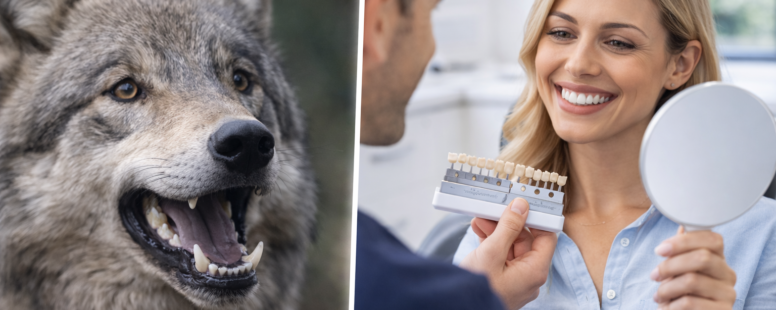
Why Humans Seek Cosmetic Dentistry While Animals Rely on Evolutionary Perfection
Across the natural world, teeth tell stories. In animals, dentition is a record of survival—shaped by millions of years of evolution to serve one purpose: function. In humans, however, teeth have taken on an additional role. They are no longer only instruments of eating, but symbols of health, confidence, and social belonging. This divergence explains why cosmetic dentistry exists for humans, while animals rely almost entirely on evolutionary perfection.
In Australia, where dentistry balances clinical excellence with lifestyle-driven expectations, this contrast is especially pronounced. Understanding it reveals not vanity, but something deeply human.
Evolution Solves Problems, Humans Create Meaning
Animal teeth are governed by evolutionary efficiency. A lion’s canines tear flesh, a horse’s molars grind fibrous plants, and a shark’s teeth regenerate endlessly to compensate for loss. There is no aesthetic debate in nature—only survival. Teeth that fail the task simply disappear from the gene pool.
Humans, by contrast, stepped outside this evolutionary contract. Cooking softened our food. Tools reduced the need for raw biting force. Social structures replaced constant physical survival. Teeth, once purely functional, became visible markers of age, status, hygiene, and even trustworthiness.
This is where cosmetic dentistry emerges—not as a rejection of nature, but as a response to culture.
The Social Weight of the Human Smile
In no other species does a smile carry such meaning. It communicates warmth, confidence, approachability, and success. Studies consistently show that people with healthy-looking smiles are perceived as more competent and trustworthy—perceptions that influence employment, relationships, and mental wellbeing.
Animals are judged by instinct and behaviour. Humans are judged by appearance, often subconsciously. This pressure is not artificial; it is social evolution.
Australian patients increasingly seek cosmetic treatments not to look “perfect,” but to look aligned with how they feel inside. Whitening, veneers, aligners, and smile rehabilitation are often less about transformation and more about removing barriers to self-expression.
Why Animals Don’t Need Cosmetic Dentistry
Animals do not experience social comparison in the human sense. A wolf with chipped teeth is not considered unsuccessful. A kangaroo with worn molars is not less worthy of companionship. Their value is not aesthetic—it is functional.
When animal teeth fail, the outcome is biological, not psychological. In humans, dental issues often trigger anxiety, embarrassment, or avoidance behaviours long before they cause physical pain.
This emotional layer is uniquely human, and it explains why dentistry here goes beyond biology into experience.
The Rise of the Dental Spa Philosophy
Modern Australian practices increasingly recognise that cosmetic care is inseparable from emotional comfort. This is why the dental spa experience aligns perfectly with the luxury and personalized patients care now expected by contemporary patients.
Animals endure dental care when necessary; humans seek reassurance, control, and calm. Soft lighting, noise reduction, gentle communication, digital previews, and unhurried consultations are not indulgences—they are responses to psychological need.
In this environment, cosmetic dentistry becomes less about appearance and more about restoration of confidence. The clinic transforms from a place of fear into a space of renewal.
Technology as a Human Equaliser
Animals rely on genetic inheritance for dental outcomes. Humans rely on innovation.
Digital scanning, CAD/CAM restorations, minimally invasive veneers, and orthodontic aligners allow modern dentistry to compensate for what evolution no longer prioritises. In Australia, where dental standards are among the highest globally, this technology supports ethical, conservative care rather than exaggerated aesthetics.
Cosmetic dentistry today is often reversible, subtle, and biologically respectful—aimed at harmony rather than dominance over nature.
Cultural Expectations Shape Dental Demand
It is no coincidence that cosmetic dentistry thrives in societies with high social interaction, visual media exposure, and professional mobility. Australia’s urban centres, outdoor lifestyle, and emphasis on personal wellbeing naturally elevate the importance of oral appearance.
Yet the most progressive practices recognise restraint. Ethical cosmetic dentistry acknowledges when not to treat, when to pause, and when to guide patients toward acceptance rather than alteration.
Animals never question their teeth. Humans do—but the best dentistry helps them stop questioning.
Function First, Aesthetics Second
Interestingly, the most successful cosmetic treatments often enhance function as much as appearance. Aligned teeth are easier to clean. Balanced bites reduce wear. Restored enamel protects sensitivity.
In this way, cosmetic dentistry quietly circles back to the animal model: function as the foundation of longevity. The difference lies in intention. Animals rely on evolution to maintain this balance. Humans use knowledge, technology, and care.
A Mirror, Not a Competition
Comparing human dentistry to animal dentition is not an argument for superiority or deficiency. It is a reminder that humans evolved not just physically, but socially and emotionally.
Where animals depend on evolutionary perfection, humans depend on adaptation. Cosmetic dentistry is one such adaptation—an intersection of science, psychology, and compassion.
And when delivered in an environment where the dental spa experience aligns perfectly with the luxury and personalized patients care, it reflects not excess, but understanding.
The human smile, unlike any other, is not just seen. It is felt.